Puzzles in Early Childhood Education: Benefits, Types, and Practical Tips
By Crossword Generator team · Published March 1, 2026 · Updated July 29, 2026
Many people see puzzles as a simple "complete the picture" game. In practice, every piece that clicks into place exercises reasoning, motor coordination, and even academic skills. This article covers what teachers and parents need to know about using puzzles with children ages 2 to 6: the real benefits, the right difficulty sequence by age, and organization tricks to avoid the mess.
What children gain from puzzles
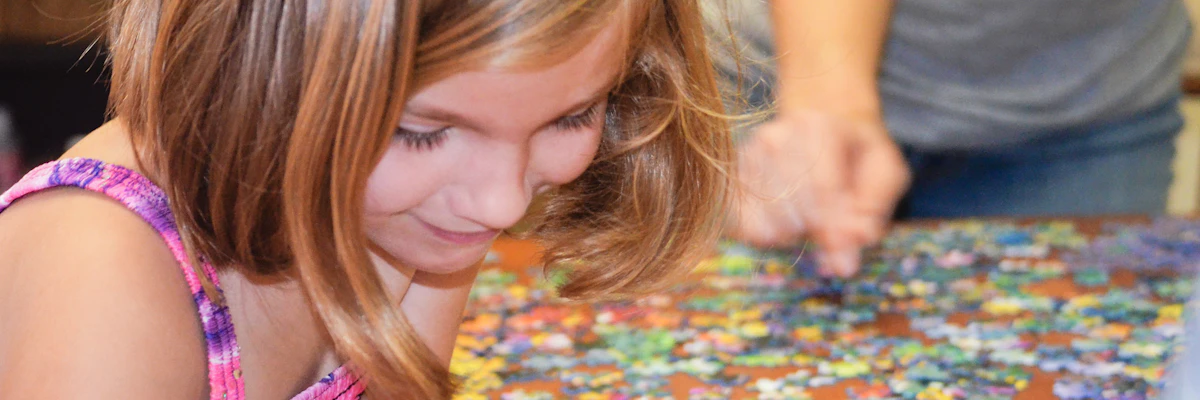
When a child picks up a piece, observes its shape, rotates it, tries to fit it, and finally gets it right, they are working three areas at once.
The first is executive function. Solving a puzzle requires logical thinking, problem-solving, and visual memory (remembering where each piece fits). It also trains attention span and spatial awareness. A 3-year-old who insists on trying a piece upside down until they notice the mistake is, without knowing it, exercising the same type of reasoning they will use to solve math problems years later.
The second is fine motor coordination. Holding pegs, rotating small pieces, and fitting them precisely strengthens the muscles of the fingers and hands. This hand-eye coordination is the same the child will need to hold a pencil and write.
The third is academic skills. Letter puzzles introduce the alphabet. Number versions teach counting. Animal-themed models expand vocabulary. All of this happens naturally, without the child feeling like they are "studying."
The right difficulty sequence by age
The most common mistake is offering a puzzle that is too hard or too easy. In both cases the child loses interest. The idea is to follow a progression that matches motor and cognitive development. For children under 4, wooden pieces are the best option because they withstand drops and biting.
Knob puzzles (ages 2 to 3)
This is the starting point. The boards have simple cutouts (animals, fruits, geometric shapes) and each piece has a button or peg for the child to grab. Start with large, thick pegs. As dexterity improves, move to smaller pegs. Most of these boards have the image repeated at the bottom of the cutout to make association easier.
Simple frame puzzles (ages 3 to 4)
After mastering the pegs, the child is ready for flat pieces that complete a basic image, usually with up to six pieces. These bases often have small cutouts along the edges that help remove the pieces with a fingertip. The challenge here is recognizing the correct orientation of the piece without the peg as a clue.
Interlocking pieces with base (ages 4 to 5)
These are pieces with the traditional puzzle cutouts, but that still fit inside a wooden frame. The frame serves as a guide: the child can use the edges and corners as reference. They typically have 4 to 8 pieces.
Interlocking pieces without base (ages 5 to 6)
Here come the floor puzzles, with large pieces the child assembles on the rug. Instead of buying tabletop versions with 50 tiny pieces that disappear under the furniture, go for the large floor models. They are easier to manage and promote collaboration: two or three children can assemble them together.
Organization tips for the classroom (and home)
Any teacher who has ever found a box with pieces from five different puzzles mixed together knows: organization is everything. Here are four tricks that work.
Smart storage
Forget the wire racks sold at toy stores. They are hard to use and frustrate children when it's time to put things away. Instead, use desk organizer trays (the kind for stacking mail). Each board goes in a separate tray, easy to pull out and put back.
Symbol system
To never waste time again figuring out which board a loose piece belongs to, grab a permanent marker and draw a symbol on the back of every piece from the same puzzle (a star, a circle, a triangle). Repeat the symbol on the back of the base. A lost piece turned up? Just flip it over and check the symbol.
Quick count
Write the total number of pieces on the back of the base. When putting things away, a quick count shows whether anything is missing.
Reference images
For floor puzzles that come in a box, cut out the image from the lid and stick it on the container where you store the pieces. Children in this age group need the visual guide. Assembling from memory alone is an advanced skill that most adults don't practice either.
Spreading puzzles around the environment
Puzzles don't need to be confined to a single play corner. The best strategy is to distribute them across different areas of the learning environment. Counting puzzles go in the math area. Letter and syllable versions go to the reading area. Animal, plant, and human body themes fit in the science area.
This rotation keeps the material varied and avoids the "seen it already" effect. The goal is to keep the difficulty level just right: not so easy that the child gets bored, not so hard that they give up.
Combining puzzles with other types of activities
Physical jigsaw puzzles work well alongside digital activities that exercise similar skills. Crosswords adapted for children, for example, work on vocabulary, reading, and logical reasoning in a different format. If you are a teacher and want to try it, you can create a custom crossword with the words your class is learning. Word searches are another option that trains visual pattern recognition, the same skill the child uses when looking for the right piece on the board.
Practical summary
Start with knob puzzles at age 2. Move to frame puzzles at 3. Introduce interlocking pieces with a base at 4. Finish with floor puzzles at 5. Mark every piece with a symbol on the back, note the count on the base, and use desk trays for storage. Spread the games around the environment and rotate their positions each week. With these steps, the puzzle goes from being just a pastime to becoming a learning tool present in everyday life.